 Wabi Sabi
Kundli matching: what your 36 points mean
Vedic matching scores two birth Moons on eight qualities, out of 36. Love Match shows which of the eight is strongest and which one is knotted.
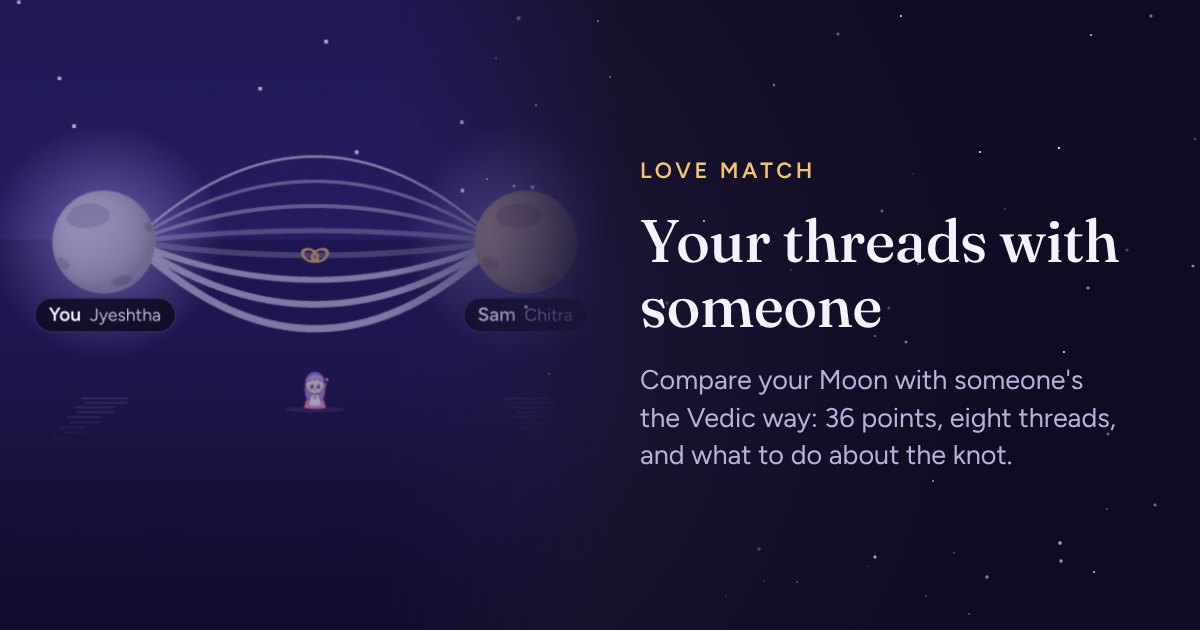
The eight kootas, and what each is worth
Varna is worth 1 point, and reads temperament. Vashya 2, for the pull between you. Tara 3, read from the distance between your two nakshatras. Yoni 4, for instinct. Graha Maitri 5, for whether the planets ruling your Moons get along. Gana 6, for whether your natures agree. Bhakoot 7, the hardest to score, for emotional and practical harmony. Nadi 8, the heaviest single thread, read here as energy rhythm. Together they make 36.
What the number is, and isn't
Eighteen is the traditional line for an acceptable match, and above twenty-five is a strong one. But the total is a screen, not a verdict: twenty-two points with Nadi at zero is a different thing from twenty-two spread evenly, and a chart scoring thirty can still have a knot in the thread that matters most to you. That's why Love Match shows you the eight threads and which one is weak, rather than only the number.
Questions people ask
How many points is a good match?
Eighteen of 36 is the traditional line, and most matches land between fifteen and twenty-five. Above twenty-five is strong. Below eighteen is worth looking at thread by thread rather than reading as a no.
What is nadi dosha?
Nadi is the eight-point thread, and when two charts share the same nadi it scores zero, which is the single biggest loss in the whole 36. Love Match describes it as an energy rhythm between you and leaves health out of it.
Does it ask who's the man and who's the woman?
No. Three of the eight kootas are traditionally scored one way round, groom against bride. Love Match scores both directions and keeps the higher, so the result doesn't depend on anyone's gender.
Do we both need birth times?
The 36 points come from the two Moons, so a date and place already give you a score. Without a birth time the Moon could have been in either of two nakshatras that day, so the reading gives a range and offers to narrow it when you add the time.